
Living, too.
Further reflections on AWP + a minor update.

This might be my last Substack article for a while. My last Sunday-published Substack article. I’ll share why, but let me start by picking up from last week’s journal-esque commentary about my experience at AWP.
Yesterday, a fellow writer — I defer to this umbrella term for my writer friends because I’m reluctant to name-drop people since they didn’t consent to featuring in my Substack, and isn’t consent an essential feature of communal interaction — posted a clip from the informal lunch we had on the second (full-day) of AWP. In the clip — which I still don’t have because WhatsApp won’t let you download status updates and I wasn’t going to comb the web for the best third-party, status-saving, ads-brimming apps — I’m half-leaning against a table, chatting with two friends. My back faces the camera. Behind us, a trio of writers discuss African poetry in a global market. If you tune out their discourse, you’d catch bites of similar conversations happening around the room, sentences punctuated every now and then by the necessary silence that a mouth full of food commands.
The bliss of this meeting was that I was only familiar with about half of the writers in the room. Of course, I knew most people, but there were at least ten writers with whom I’d never chatted until arriving at AWP. This, then, was delight. Hearing your interests ferried across the room, hearing others articulate questions that poked your thoughts. Thinking, is this what it feels like?
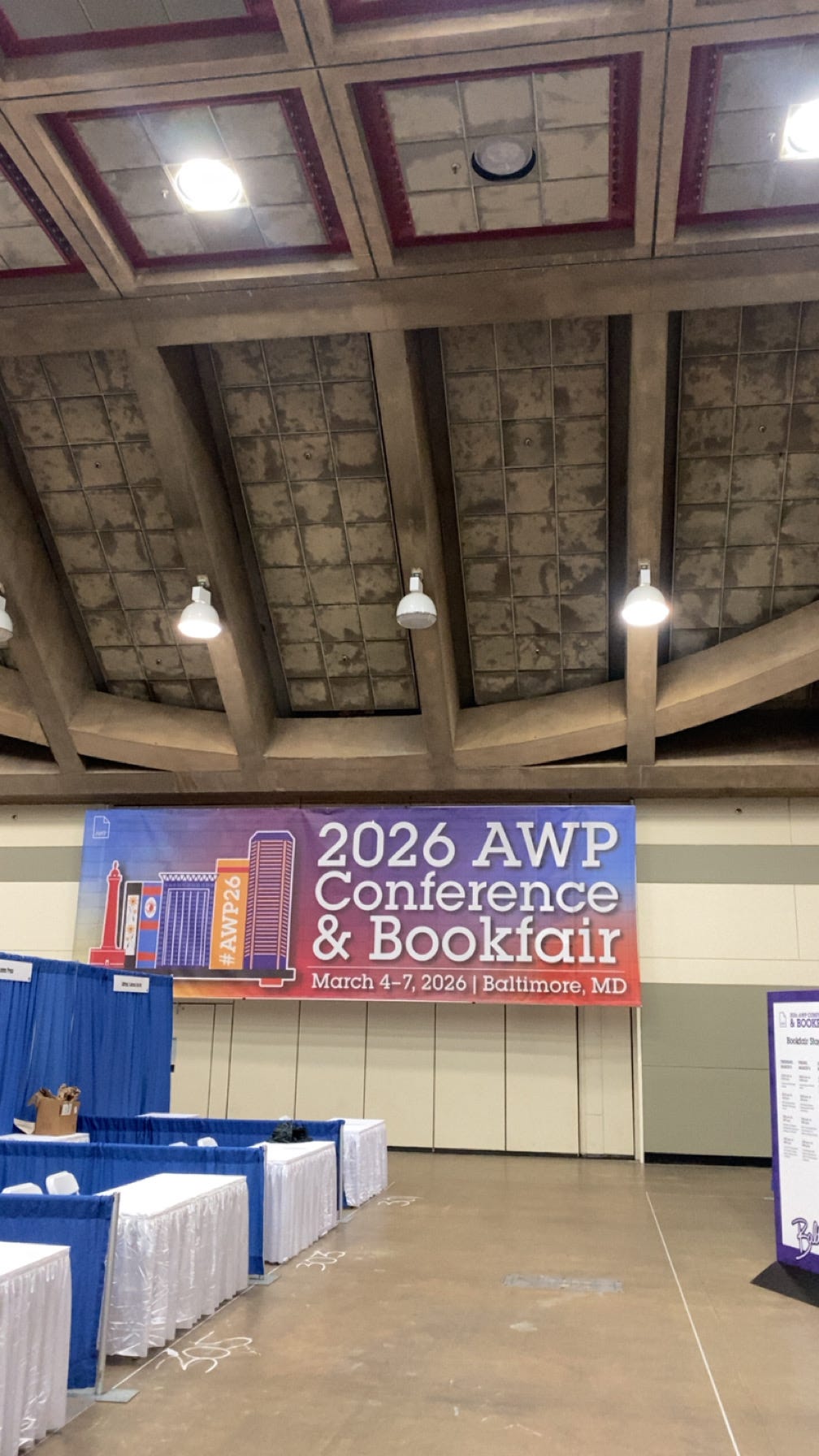
This feathery feeling lingered during AWP. When we arrived at the Convention Center to check in, I was surprised to meet over fourscore writers waiting in line. This was about 3pm on Wednesday, and events weren’t due until 8am the next day. In fact, I knew at least a dozen writers—colleagues, friends, publishers—yet to get to Baltimore. Walking up to the lady at the registration desk, I thought, “Just how many people would be in this queue tomorrow?” (it was well over five hundred people the next morning!)
When we’d gotten our cards, we canvassed the site of the book fair. I was struck, first, at the stretch of tables from one end of the space to the other. As we made our way down that first aisle, I spotted a few journals I knew from social media or from rejection mails. When we reached the end, I looked to the left and all I saw were booths assigned to presses and publishers and journals and writing programs across the country. The right, too, had its share. When my friend asked if we needed to locate our journal’s booth, and we walked about five minutes before finding the table, I realised, in partial awe, just how many publishing brands were represented here.
Given, it was my first AWP appearance, so this excitement was unsurprising. But the long list of names wasn’t the sole thing that got me kicking my feet. It was the awareness of representation.
When, eleven years ago, I really started writing what I consider my first full manuscript — a 40,000-word novel set in an invented city — I didn’t know what to do with the story, or with this urge that returned me to the blank page with or without my permission. I’d read a good number of books then — books off the reading list of the literature class my mum taught, books I randomly found in her library — but I had no clue about how publishing worked. And I didn’t know anyone else figuring out the same journey. It took about six months before my brother introduced me to a couple writers on Facebook, and another year before I happened on a US-based literary agency and started engaging their blogs from my room in Lagos (here, I paused to look them up and, no surprise, the founder still put up a blog post two days ago!).
A lot, minor and major, has changed since then, but I haven’t forgotten the days of churning out a short story after another, not knowing where they led, not knowing if people still published books or read books. So to see all those publishers and presses at AWP? That was my teenage self feeling seen, however trivial.
Now to the Opening Statement
When I published my first Substack piece in October, I sent it out on a Sunday because I decided, the night before, that it was time to. I wouldn’t overthink it anymore. The next Sunday, I wrote another because I had a long week and hadn’t the time to compose until late Saturday night. And so, Sunday became the day I published on Substack.
A logical decision, as I often had to navigate coursework, campus duties, and other graduate student demands between Mondays and Fridays. Saturdays were irregular — sometimes I was out for hours trying to grocery shop or find student-affordable winter outfits, and sometimes I slept in because I stayed up late on Friday night watching a movie. I was very happy to work with Sundays. I looked forward to getting back from church, sitting at the laptop, and fleshing out ideas I’d tossed and turned all week.
I still carry this enthusiasm, but Sundays aren’t as free as they were last semester. As I write this, the first few pages of Woolf’s Orlando are open beside me; I also have a pending writing task to turn in before midnight. So, yes, I am mindful of every minute it takes to get this one ready.
I appreciate how showing up each day has taught me consistency. Once, my brother mentioned how Seth Godin has published every day for over a decade. That’s a level to aspire to.
However, I’d also be mindful to acknowledge that no two months are the same. Looking at the next few weeks, I can’t be sure that I’d have sufficient window to gather myself onto the page every Sunday. I’m a big fan of organic creation—the thoughts pooling together, the words fitting one another like LEGO pieces. If I’m in a time crunch each time I sit to write, this can muddle the organic process.
I’m not pulling the plug on Substack. Instead, I’m becoming more flexible with the publishing schedule. I’ll still attempt writing once weekly. The next post after this one might still go out on a Sunday.
What’s changing is that if Saturday works best to hit publish, Saturday it will be. And if Tuesday night, Tuesday night it will be. If I need to write twice a week — say, for instance, I can’t stifle the yearning to contribute to the “westernizations” discourse and I have already written for that week — then twice a week we shall have.
That’s it, that’s all the change.
Thank you, really, for reading this far. Altogether, my pieces have been read over 1000 times. Thank you for lending me your time! Thank you for not marking as read (like you can do and like I do with newsletters as well). Thank you for being gracious.
I’ll write again, soon!
Awn, I loved reading this on Monday's my time and I look forward to the next post.