
From the Library
about a Sunday evening.

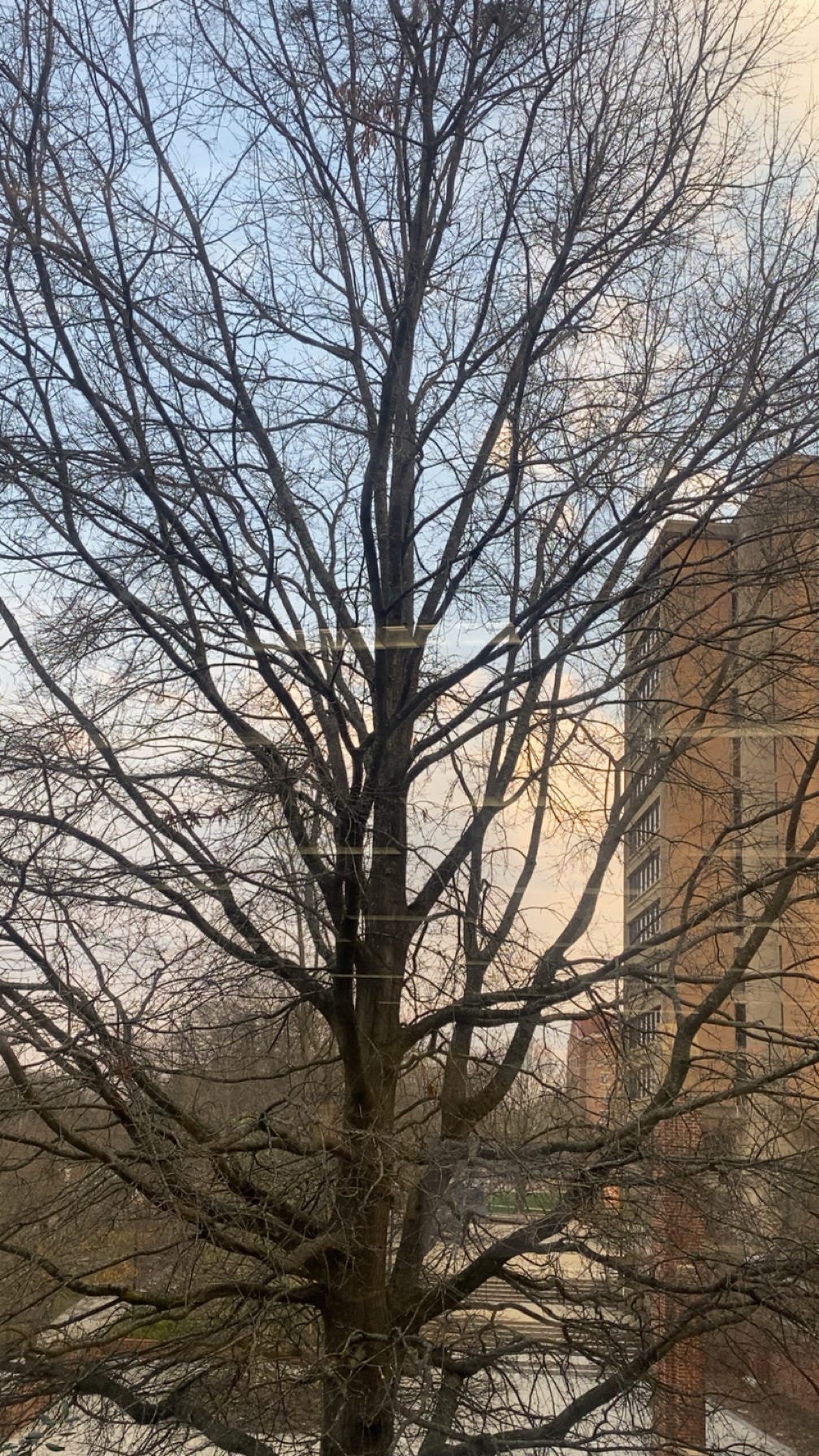
I write this from a desk in the library. I am sat by the window overlooking a walkway where for the last three hours, young men and women have walked by, dressed in shorts and short-sleeved shirts, swinging bunches of keys or scrolling absentmindedly. Or chatting about the day, how bright, how gentle, how warm it is. Directly by the window a large tree looms, withered from stem to axils, its bark so dry it’s difficult to guess what leaves once made habitat here, what species of tree once lived here. The dry branches stretch out scatteredly, across all compass points. When a wave of breeze sweeps by, a light branch attempts to sway. Below the tree, where a forest of green would have offered shade, sits a mound of earth. Brown earth, serenaded by a variety of leaves—green, drying, yellowing, withering. A sprinkle of post-it notes spread over these leaves such that the soil pops with colors.
The first time I saw a tree wither, I stood by the window and watched the tree recede into its former glory. This was about one month into Fall. The apartment had begun to get cold, and my neighbor had affirmed that the heating would soon be turned on to negate inevitable shivers. Still, I left my window open, curtains pulled up, as the breeze melted into my skin. Before me, a spectacular sight, leaves falling off the tree unprovoked, as though the tree was suddenly starved and could no longer put up with the task of supplying life to the branches, and was regretting its failure at its lifelong pledge.
For years, I had read about seasons, about Fall, Spring, Summer, and Winter (as you might notice, I didn’t put them in order of appearance because it wasn’t always my default arrangement). I knew that it rained in Spring, that families flocked the beaches and swam oceans-length and played Frisbee in Summer, that in Winter everyone bundled up, wore layers, dressed like fashionable aliens, and anticipated snow. But this was all I knew. Though we experienced seasonal changes in Nigeria—it got unkindly cold in December and could rain a torrent between April and September—I didn’t always think about Nigeria’s weather fluctuations as seasonal changes.
Snow was a strange concept. An experience we identified with from consuming Western media, mostly with good intentions. Snowfall was a dream we lived through distant kins—friends of cousins who’d gone to study or for a vacation and had been to Chicago, New York, Manchester, Berlin. Chicago, if I recall well, was the first Western city I learned of, the first place I could pin to a country outside mine. I was ten or eleven. I had watched football for two years, and knew of a prodigy named Messi shocking world football. I knew he played for Barcelona FC, yet I couldn’t pinpoint where Barcelona was.
But I knew Chicago, because a childhood friend had seen a film where a character had uttered the line, “I am going to Chicago.” Till date, I don’t know what film. Yet, that naming stayed with me, redefined how I thought about places, about the snow. Watching those leaves limp off the branches and sail towards the concrete, unrushed, in groups of threes and fours, in rhythm, as though responding to a music played by a master composer, I held a little smile.
So this was it. Fall, beginning. What bliss, though I felt no bliss. Instead, I remembered an assignment due in two hours, got back to my computer, and resumed work.
This moment returns to me now, watching the lone, stalwart tree sigh now that winter is almost ended. It’s my fourth hour at the library. Prior to starting this narrative, which I’m yet to title because I started on a whim, I was reading a short story for class, a wonderful piece by Katherine Mansfield, who, before this semester, I don’t recall ever reading. Like Woolf, whose works I’ve become acquainted with since the turn of this year, Mansfield was also a modernist writer. She was a well-recognised author at the time of her writing, and in select spheres, she still commands that revere. When I saw her name in a course description last semester, I was surprised I hadn’t ever come across the name. Yet, one of the significant lessons a degree in Creative Writing teaches is that the journey of reading never ends, and with that, the journey of discovering new authors.
At the library, there are five other people working on twin computers (here, I mean that they use a computer connected to another screen). I met four of them when I arrived here, and the last person came in shortly after me. They’re all plugged in, and once or twice an hour someone ejects a word, perhaps forgetting that they’re in a library, in the quiet section. But I get it. You become so absorbed into what you hear you forget there’s another world existing outside the walls of that music.
I didn’t plan to stay this long at the library. I’d hoped to finish working on some slides for a project, do some reading for class, and edit a couple of poems. But then time’s wings rushed by and the hours flattened. Soon, dusk descended from the horizon and I wasn’t even done reading. And I hadn’t written anything for Substack.
I have published every Sunday for over five months, and I’d say it’s been a long walk of commitment. I imagine that someday I might skip a period, or I might move an episode from a Sunday to a Monday. I imagine that it wouldn’t make a ton of difference, because what counts more is that the words exist, that I bring them to you and you see them, that someday a stranger can happen upon them.
Yet, I find myself unwilling to embrace the thought of skipping a Sunday, even if it means pausing my coursework reading to accommodate an hour (or more) of writing. So as dusk flutters, I pull up a blank page and begin to type.
I will be at a writers’ conference for a few days this week, and I had initially thought I would write about my thoughts building up to being at this conference, an event I’d wanted to attend for three, four years? But now the post is done and I haven’t talked about this conference. Perhaps next week, when I’ll have returned from the conference. Perhaps.